
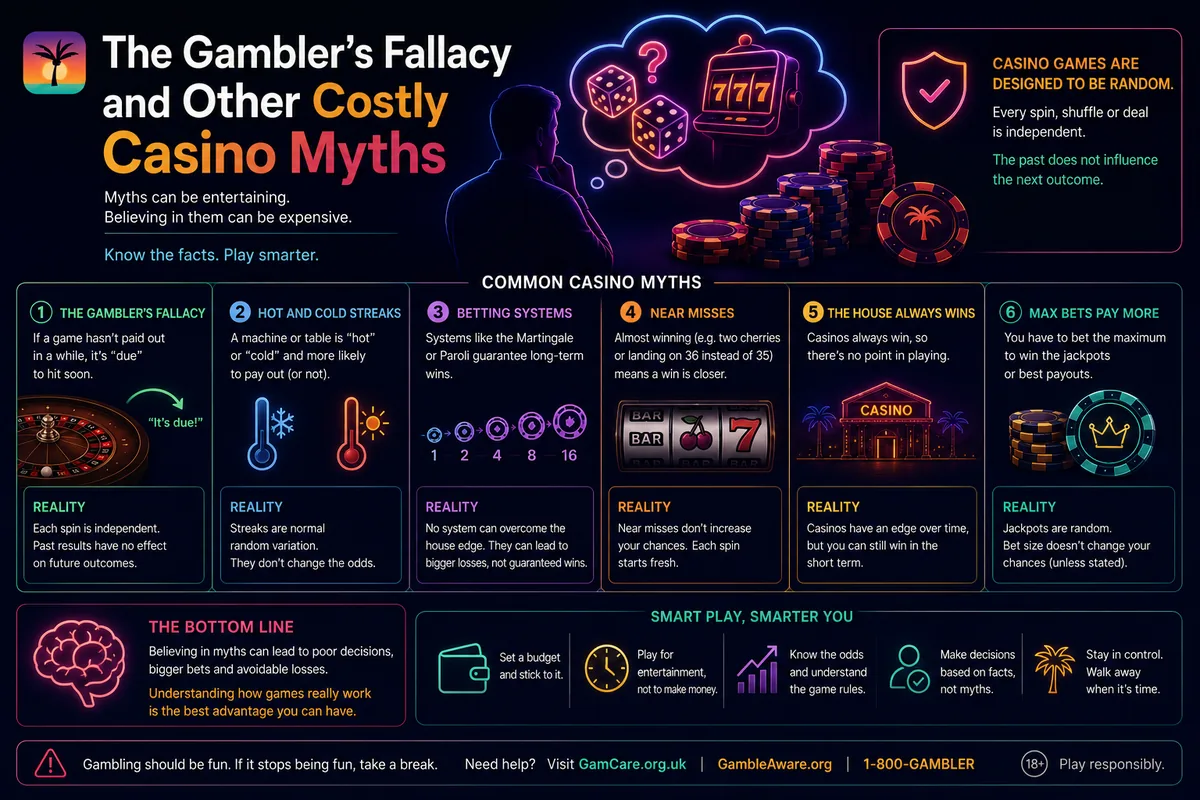
The one idea that dismantles most myths
Almost every costly casino belief traces back to a single misunderstanding, and it is not about maths so much as about memory. People assume the game remembers what just happened. It does not. A roulette wheel has no record of the last spin, a slot's random number generator does not know whether it paid out an hour ago, and a shuffled shoe of cards is indifferent to the hand before. Each event is independent, which means the odds reset completely every single time, no matter what came before.
Sit that idea next to one number, the house edge, and you have the whole picture. The house edge is the slice of every bet the casino keeps on average over time. European roulette holds about 2.7%, American roulette about 5.26% because of the extra double-zero, and a mainstream online slot typically returns somewhere between 94% and 97%, keeping the rest. That edge does not switch off during a losing streak or a winning one. It is baked into the rules of the game and it applies to every bet you place, forever, whichever way the last one went.
So the useful question is never "am I due?" It is "what is the expected value of this bet?" Expected value, or EV, is just the long-run average outcome. On a game with a house edge, EV is negative, and no pattern in past results, no ritual, and no staking plan changes that. Before we go through the myths one by one, here is the short version of what is true and what is not.
| The myth | What people believe | The reality |
|---|---|---|
| Gambler's fallacy | Red is due after a run of black | Each spin is independent; odds reset every time |
| Hot hand | A winning streak means you are running good | Past wins do not raise the odds of the next one |
| Hot and cold slots | A machine that has not paid is close to paying | RNG plus fixed RTP; there is no stored, owed payout |
| Loose slots | Some seats or times pay more | Return is set in software, identical on every spin |
| Betting systems | Smart staking beats the house | Staking never changes EV; it only moves risk around |
| Chasing losses | One more bet wins it back | Losses are gone; the next bet has its own negative EV |
The gambler's fallacy: nothing is ever "due"
The classic version happens at the roulette table. Black lands eight times in a row, a small crowd forms, and money piles onto red because red is "overdue". The wheel does not care. On a European wheel the chance of red on the next spin is 18 in 37, roughly 48.6%, exactly what it was before the run started and exactly what it will be on the spin after. The eight blacks are already in the past. They have no vote in what the ball does next.
The confusion comes from mixing up two different questions. The probability of eight blacks in a row, predicted in advance, is genuinely tiny, about one in 350. But once eight blacks have already happened, that unlikely sequence is complete and settled. Asking about the ninth spin is a brand new question with a plain answer near one in two. Long streaks feel like they are bending toward a correction, but the wheel has no mechanism to deliver one. There is no cosmic scoreboard rebalancing the colours.
This is not a harmless quirk of thinking. In 1913, at the Monte Carlo Casino, black came up 26 times in a row on a single wheel. Players lost fortunes betting ever larger sums on red, convinced each spin that the correction had to be imminent. It never was. That night is why the mistake is sometimes called the Monte Carlo fallacy, and the lesson has not aged: a streak is not a debt the game owes you. It is just a streak, and the next spin is a coin the wheel has never flipped before.
The hot hand and the "on a roll" feeling
The hot hand is the gambler's fallacy wearing the opposite coat. Instead of expecting a reversal, you expect the streak to continue, because you are "running hot" or the night is "your night". Three blackjack wins in a row feel like proof the deck loves you, so you raise your stake to ride the wave. The wave is not real. In a game of independent trials, three wins tell you nothing about the fourth. The cards do not know you are winning, and momentum is not a force that operates on a shuffled shoe.
What makes this one sticky is that hot streaks genuinely happen. Randomness is lumpy, not smooth. Flip a fair coin two hundred times and you will almost certainly see a run of six or seven heads somewhere in there, purely by chance. Our brains are pattern-finding machines and they treat those lumps as meaningful, as a signal to act on, when they are just the ordinary texture of random data. Seeing a streak is normal. Believing it predicts the next result is the error.
The practical damage is in the staking. People bet small when they feel cold and large when they feel hot, which sounds like discipline and is actually just betting big at random moments. Since every bet carries the same negative EV, sizing your stake by a feeling of momentum does nothing but increase how much you have riding on the house edge exactly when you can least afford it. The feeling is real. The edge it seems to give you is not.
Hot machines, cold machines and "loose slots"
Walk any slots floor, online or physical, and you will hear the folklore. That machine is cold, it hasn't paid all day, so it's about to pop. This one is hot, leave it alone. The aisle by the door has the loose slots. The machines near the cashier are tight. All of it rests on the same broken assumption as the gambler's fallacy, dressed up in hardware, and none of it survives contact with how the games actually work.
Every modern slot runs on a random number generator that produces thousands of numbers per second, continuously, whether anyone is playing or not. The instant you press spin, the current number is grabbed and mapped to a result. That result depends on nothing before it. The machine holds no memory of how long since the last jackpot and no ledger of an owed payout building up. A game that has paid nothing for six hours has precisely the same odds on the next spin as a game that paid a jackpot ninety seconds ago.
Sitting over the top of the RNG is the RTP, the return to player, a fixed figure certified and locked into the software. If a slot is set to 96% RTP, it is designed to return 96 pence of every pound wagered across millions of spins. That percentage is a long-run average measured over an astronomical number of plays, not a promise about your session or your afternoon. It does not warm up, cool down, or come due. A "cold" machine is not saving up. It is just a machine that has been on the wrong side of variance for a while, which tells you nothing.
"Loose slots" in a good location is the same myth in a hat. In a regulated online casino the RTP is a software setting a lab has verified, identical no matter where you sit, what time it is, or how you feel about your luck. The only real, checkable difference between slots is the published RTP itself, and a small handful of percentage points there matters far more than any story about hot aisles. Read the number in the game info panel. Ignore the folklore.
Why no betting system beats the house edge
Betting systems are the most seductive myth because they feel mathematical, and the most famous is the Martingale. The rule is simple: bet on an even-money outcome like red, and every time you lose, double your next bet. When you finally win, the doubled stake recovers every prior loss plus one unit of profit. Then you reset and start again. On paper it looks unbeatable, a machine that turns any win into a guaranteed one-unit gain. On a real table it is a slow way to lose everything at once.
Two walls bring it down, and you hit both. The first is the table limit. Casinos cap the maximum bet on every table precisely so that doubling cannot run forever. The second is your bankroll, which is smaller than you think once the numbers start doubling. A losing streak of just a few spins sends the required stake into the hundreds, then the thousands, faster than intuition expects. And remember the gambler's fallacy above: a run of losses does not make the next win more likely, so the streak that ruins you is not rare, it is inevitable if you play long enough. Here is the doubling laid out from a 10 euro base bet.
| Loss # | This bet | Total staked so far | Profit if this bet wins |
|---|---|---|---|
| 1 | 10 euro | 10 euro | 10 euro |
| 2 | 20 euro | 30 euro | 10 euro |
| 3 | 40 euro | 70 euro | 10 euro |
| 4 | 80 euro | 150 euro | 10 euro |
| 5 | 160 euro | 310 euro | 10 euro |
| 6 | 320 euro | 630 euro | 10 euro |
| 7 | 640 euro | 1,270 euro | 10 euro |
| 8 | 1,280 euro | 2,550 euro | 10 euro |
Read the last two columns together and the trap is obvious. By the eighth loss you are staking 1,280 euro to win back a 10 euro profit, having already risked 2,550 euro to get there. A losing run of eight on an even-money bet is far from freakish; on European roulette it happens roughly one session in three hundred, and most tables have a maximum bet that stops your doubling well before you can recover. The moment you cannot place the next double, whether because the table caps it or your account is empty, the whole chain collapses and you lose everything you staked in one go. The system did not fail you on a technicality. It converted many small wins into one catastrophic loss, which is exactly the shape it always had.
Every other system has the same flaw underneath. Fibonacci, d'Alembert, Labouchere, reverse Martingale, they rearrange when and how much you bet, and some produce lots of small wins that feel like a working method. None of them touch the house edge. Expected value is set by the odds of the bet, not by the pattern of your staking, and the sum of a series of negative-EV bets is negative no matter how cleverly you order the stakes. A system can change your chance of a small win versus a large loss on a given night. It cannot make the maths add up in your favour over time.
Near-miss design and how it plays your brain
Some myths live in your head; this one is engineered into the game. A near miss is when a result lands agonisingly close to a win: two jackpot symbols on the payline and the third just above it, or a fruit machine reel that stops one position short. It is not a win and it pays nothing, yet it lights up reward circuitry in the brain almost as strongly as a real win does. That is not an accident of the reels. It is a design choice, refined over decades, because near misses keep people playing.
On a genuinely random game, a symbol landing one line off is meaningless, exactly as far from a win as any other losing combination. But developers can weight the virtual reels so that near-miss outcomes appear more often than pure chance would produce, making "so close" feel like "almost there". Your brain reads it as progress, as a sign you are warming up, when nothing about your odds has moved a millimetre. The near miss manufactures the feeling of the hot streak without any of the payout.
Knowing the mechanism is the defence. When a spin stops one symbol short and you feel the urge to go again immediately, that pull is the design working, not information about the next spin. There is no "almost", because independence means every spin starts from zero. The most useful thing you can do is name the feeling for what it is, a manufactured nudge, and let it pass rather than pressing spin on the back of it.
Chasing losses and the sunk-cost trap
This is the myth that does the most real harm, because it feels like the responsible choice. You are down 200 euro, so you keep playing to win it back, telling yourself you cannot walk away at a loss. That is the sunk-cost fallacy, the same bad instinct that makes people sit through a film they are hating because they paid for the ticket. The 200 euro is already gone. It is not on the table waiting to be reclaimed. It exists only in the past, and no future bet is connected to it.
The maths is blunt. Your next bet has exactly the same negative expected value it always had, no matter how far down you are. The size of your losses does not improve your odds by a single percentage point, and chasing usually means betting bigger and less carefully, which increases the house's take rather than shrinking your deficit. The deeper you dig, the more the pattern that feels like recovery is just faster loss. Chasing does not claw money back. It accelerates the direction you were already heading.
The only reliable protection is a decision made before emotion is in the room. Set a loss limit before you deposit and treat it as a hard stop, not a suggestion you renegotiate at the moment it bites. Set a win limit too, so a good run does not evaporate through the belief that it has to continue. Best of all, decide your walk-away rules in advance and let a timer or a deposit limit enforce them, because the version of you that is 200 euro down is the worst possible person to be making that call. In the UK, GamCare and BeGambleAware offer free, confidential help, and every licensed site we review carries deposit limits, reality-check reminders and self-exclusion in the account settings. Using them is not admitting defeat. It is the one genuinely winning move in a game built with a house edge.
The real edges people mistake for luck
To be fair to the maths, a couple of things people lump in with luck are real, and it is worth being precise about what they can and cannot do. The clearest is blackjack basic strategy. Blackjack is not a pure game of chance, because your decisions change the odds, and there is a mathematically correct action for every combination of your hand and the dealer's up card. Play it perfectly and you can shave the house edge down to around 0.5% on good rules. That is genuinely the best value on most casino floors, but read it carefully: 0.5% is still a house edge. Basic strategy reduces the edge; it never flips it in your favour.
Then there is advantage play, the umbrella term for methods like card counting that can, in narrow conditions, tilt the odds slightly toward the player. It is real, it is legal in the sense that it uses only your own brain, and it is nothing like the movies. It requires a game with the right rules, a large bankroll to survive the swings, sharp discipline over long hours, and a tolerance for being asked to leave, because casinos are private businesses and can bar anyone they suspect. Online, continuous shuffling and RNG-based tables shut most of it down entirely. For any casual player, advantage play is not a strategy, it is a specialist profession, and treating a betting system or a lucky feeling as if it were advantage play is precisely the confusion this guide exists to clear up.
So keep the two categories separate. There are games where skill measurably reduces the house edge, and you should absolutely learn the correct play if you enjoy them. And there is everything else, where the edge is fixed, the events are independent, and the outcome over time is not in doubt. The honest summary is that the house edge is the price of the entertainment. Understanding these myths will not turn a losing game into a winning one. It will stop you paying extra on top of the price, chasing corrections that never come.
Frequently asked questions
If red hits eight times, isn't black more likely next?
No. That is the gambler's fallacy. The wheel has no memory, so the odds of black on the next spin are the same as they always are, about 48.6% on a European wheel, regardless of the run before it. Each spin is a completely independent event, and past results have no influence on the next one.
Can a slot machine be "due" for a payout?
No. Slots use a random number generator with no memory and a fixed return to player set in software. A machine that has not paid in hours has identical odds on the next spin to one that just paid a jackpot. There is no stored, owed payout building up inside it. RTP is a long-run average over millions of spins, not a promise about your session.
Does the Martingale system actually work?
Only until it doesn't, and then it fails badly. Doubling after every loss recovers your losses on paper, but table limits and the size of your bankroll cap how far you can double. A losing streak of eight, which is far from rare, can require you to stake over a thousand euro to win back ten. It turns many small wins into one catastrophic loss and never changes the house edge.
Are some slots "looser" than others depending on where they are?
No. In a regulated casino the RTP is a certified software setting, identical no matter where a machine sits, what time you play, or how you feel about your luck. The only meaningful difference between slots is the published RTP figure itself, which you can check in the game's info panel. Location-based "loose slots" folklore has no basis in how the games work.
What is a near miss and why does it feel so significant?
A near miss is a losing result that lands just short of a win, like two jackpot symbols with the third one position off. It pays nothing, but it triggers reward responses in the brain almost like a real win, which keeps players spinning. Developers can weight virtual reels to show near misses more often than chance would. It is a design feature, not a sign you are close to winning.
Does blackjack basic strategy let me beat the casino?
Not quite. Playing perfect basic strategy reduces the house edge to around 0.5% on favourable rules, which is excellent value, but it is still an edge in the casino's favour, not yours. It lowers how much you lose over time rather than flipping the game positive. Advantage play like card counting can shift the odds slightly, but it demands a large bankroll, ideal conditions and serious discipline, and it is not realistic for casual players.
The habits that actually protect your money are boring: set a budget before you deposit, treat any stake as the cost of entertainment rather than an investment, and use the deposit limits and walk-away tools every licensed site provides. Every casino we recommend on our top-rated list publishes its terms plainly and carries the responsible-gambling tools built in. 18+ only. If gambling stops feeling like a game, GamCare and BeGambleAware offer free, confidential support.