
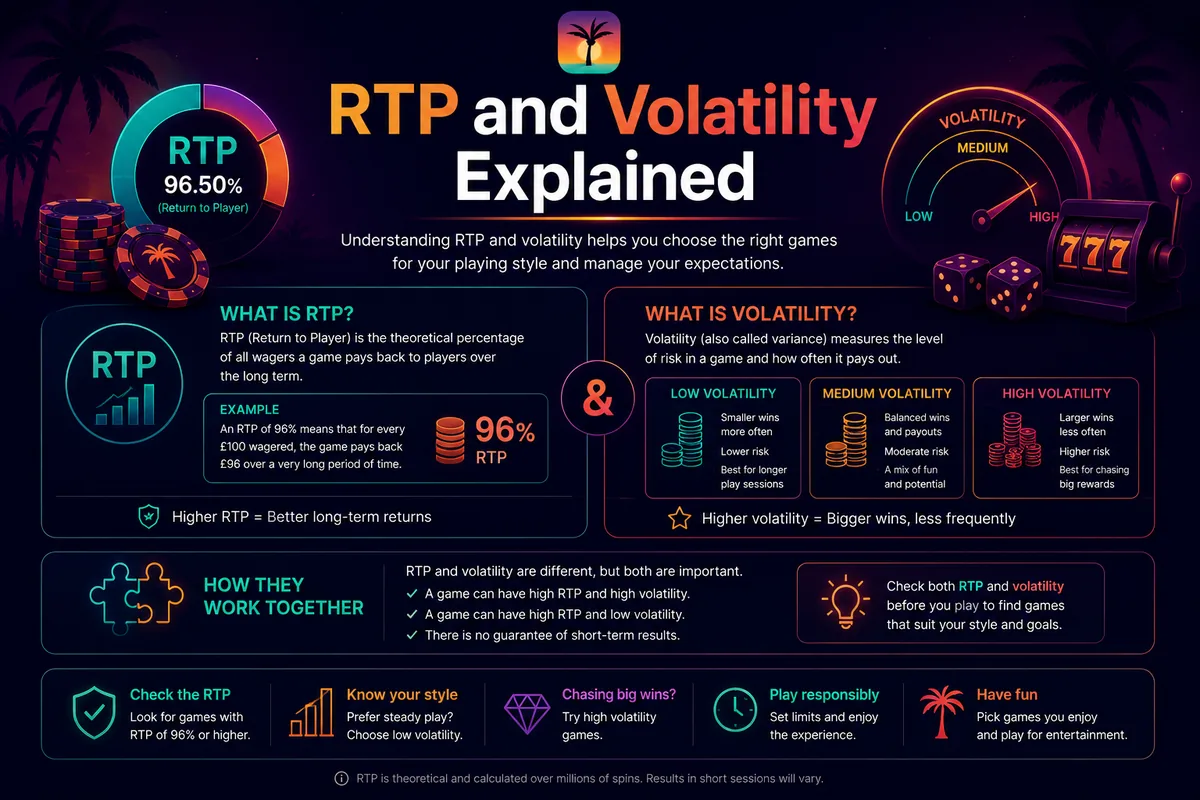
What RTP actually means
RTP stands for Return to Player, and it is the single most quoted, most misread number in an online casino. A slot with 96% RTP is built to return, on average, 96 pence of every pound staked. The other 4 pence is the house edge, the margin the operator keeps. That is the whole definition. Simple to state, and almost always misunderstood in one specific way.
Here is the part the marketing never spells out. The 96% is a theoretical figure measured over millions of spins, the kind of sample a maths model produces, not a number that describes your Tuesday evening. It is the destination the results drift towards across the entire life of the game, played by everyone at once. Your own hundred spins can return 300%, or zero. Both are completely normal. RTP is the average of a vast crowd of sessions, and no individual session is obligated to look anything like it.
Think of it the way an insurer thinks about a book of policies. The insurer knows the long-run cost of a million drivers to a fraction of a penny, and hasn't the faintest idea what any single driver will do next year. The casino is on the insurer's side of that equation. You are one driver. The 96% is their number, calm and reliable across the whole book. Yours is the wild one, and it stays wild no matter how long you sit there, because "long run" in RTP terms means far more spins than a person plays in a lifetime.
House edge, and what it really costs per hour
Flip RTP around and you get the house edge: 100% minus the RTP. A 96% game carries a 4% edge, a 94% game a 6% edge, a 98% game a 2% edge. That edge is the price of admission, and unlike a cinema ticket it is charged on every pound you stake, not once at the door. The trick to understanding what a game costs is to stop thinking about one spin and start thinking about total money wagered.
Work a real example. You are playing a 96% slot at 1 pound a spin, and slots run fast, so call it 200 spins an hour, which is a steady but unhurried pace. In that hour you stake 200 pounds. Not lose, stake. The same pound cycles through the machine again and again as wins get re-bet. The house edge takes 4% of that turnover, so your expected loss for the hour is 4% of 200 pounds, which is 8 pounds. That is the true hourly cost of the entertainment, on average, and it is a far more honest figure than the 1 pound you thought you were risking per press.
Change any input and the cost moves in a way you can now predict. Double the stake to 2 pounds and the expected hourly loss doubles to 16 pounds. Halve the RTP gap by moving to a 98% game and the cost halves to 4 pounds. Play a nasty 88% machine and you are handing over 24 pounds an hour on the same pace and stake. The table below prices a single hour of play at 1 pound and 200 spins across a spread of RTPs, so you can see how the same speed produces wildly different bills.
| Game RTP | House edge | Staked per hour (200 x 1 pound) | Expected hourly loss | Typical example |
|---|---|---|---|---|
| 99% | 1% | 200 pounds | ~2 pounds | Some jackpot-free classic slots |
| 98% | 2% | 200 pounds | ~4 pounds | High-RTP branded slots |
| 97% | 3% | 200 pounds | ~6 pounds | Well-tuned modern video slots |
| 96% | 4% | 200 pounds | ~8 pounds | The mainstream default |
| 94% | 6% | 200 pounds | ~12 pounds | Feature-heavy or licensed games |
| 92% | 8% | 200 pounds | ~16 pounds | Lower configured versions |
| 88% | 12% | 200 pounds | ~24 pounds | Cut-down or land-style machines |
Two lessons fall straight out of that table. First, the gap between a 96% and a 92% game is not a rounding error, it is twice the hourly cost, and you would never know from playing. Second, none of these figures is what happens to you on the night. They are the meter running in the background, the average bill across thousands of players. Which brings us to the number that decides how far your own night swings away from that average.
Volatility: how the money is distributed
RTP tells you how much a game pays back. Volatility, also called variance, tells you how it pays it back: in a steady drizzle of small wins, or in long droughts broken by the occasional downpour. Two games can share an identical 96% RTP and feel like completely different hobbies, because the return is packaged and delivered in opposite ways. RTP is the size of the pie. Volatility is how it is sliced.
Low-volatility games pay often and pay small. The line hits land regularly, the balance ticks along, and a session feels alive even when you are slowly drifting down. You rarely see a big number, but you rarely see a brutal cold streak either. High-volatility games do the reverse. They can eat through fifty, a hundred, two hundred spins giving you almost nothing, then hand back everything and more in a single bonus round. The published RTP is the same in both cases; it just arrives on very different schedules.
This matters more than most players realise, because volatility, not RTP, is what usually empties a bankroll before the fun starts. A high-variance game with a modest stake can still wipe out a small balance in a cold run that is entirely normal for that game. The RTP was never going to save you inside a hundred spins, because a hundred spins is nowhere near the long run. The table below sketches how the three broad bands actually feel at the screen, and roughly what bankroll each one asks for if you want a session to last.
| Volatility band | Win frequency | Typical win size | What a session feels like | Bankroll it asks for |
|---|---|---|---|---|
| Low | Frequent, most spins pay something | Small, often below your stake | Steady, gentle, few big swings either way | Modest, 50 to 100 spins is survivable |
| Medium | Moderate, regular dead spins | Mixed, occasional decent hit | A rhythm of ups and downs, some tension | Comfortable, 150 to 250 spins of buffer |
| High | Rare, long dry stretches | Large, driven by bonus rounds | Boredom then chaos, big potential, deep dips | Deep, 300 spins plus or expect to bust early |
Providers usually publish a volatility rating in the game's information screen, often as a one-to-five scale or a plain low/medium/high label. It is a guide, not a guarantee, and different studios calibrate their scales differently. But it tells you what kind of ride you are buying before you spend a penny, and it is the number I check first when a bankroll is small.
Same RTP, very different nights
Put the two numbers together and you can finally predict how a game will behave. RTP sets the long-run cost. Volatility sets how far a real session is allowed to stray from that cost, in either direction. A game can be generous on paper and vicious in practice, or cheap-looking and gentle, depending entirely on how those two dials are set.
Picture two slots, both 96% RTP, both played at 1 pound for that same 200-spin hour. The low-volatility one drips wins the whole way. You might finish 5 pounds down, maybe 10 up, and the graph of your balance looks like a mild slope with small bumps. The high-volatility one might take 180 dead spins to hand you a single bonus that returns four times your hour's stake, or it might give you nothing at all and leave you 60 pounds down before the free spins that never came. Averaged across ten thousand players, both settle at that 4% edge. Averaged across you, on one night, they are barely the same game.
That is the core insight of this whole guide. RTP is a promise made to the crowd, and volatility is the fine print on how disorderly your individual share of that promise is allowed to be. When someone says a slot is "high RTP so it pays well", they have quietly assumed the two numbers are the same thing. They are not. A 97% high-variance slot can and will hurt more in a short session than a 95% low-variance one, and neither fact contradicts the other.
Where to find a game's RTP
Every reputable slot carries its RTP in the game itself. Open the game, find the menu or the small "i" icon, and look for the paytable or game information screen. The RTP is usually stated near the rules, phrased as "theoretical return to player" or "the average return over long-term play". If a game hides that number completely, treat it as a warning sign; the good studios are proud of the figure and print it plainly.
Now the part that catches even experienced players. Many popular slots ship in more than one RTP version, and the operator chooses which one to run. A game the developer built at 96% might also exist as a 94% build, a 92% build, and sometimes an 88% build. Same art, same sounds, same bonus, lower return. The casino picks the configuration when it licenses the game, and you get whatever they have switched on. This is entirely legal at licensed sites and disclosed inside the paytable, which is exactly why you check the paytable rather than trusting a review that quoted the top figure.
So the habit is: check the RTP in the actual game you are about to play, not on a database or a promo page, because the database usually lists the developer's flagship version and the operator may be serving a lower one. Two casinos can offer the "same" slot with a two or three point gap in return, and over the hours that gap is real money. When we test operators for our online slots lists, the configured RTP on their live games is one of the things we log, because a site quietly running cut-down versions tells you how it thinks about its players.
RTP on table games and side bets
RTP is not just a slots idea. It applies to everything in the casino, and on table games the numbers are usually far kinder, with one loud exception. Blackjack, played with correct basic strategy, runs an RTP of around 99.5%, a house edge near half a percent, which is about as good as a casino game gets. That figure assumes you play the mathematically correct move every hand; deviate on instinct and you hand the edge back fast, so the 99.5% is a skill number, not a gift.
Roulette shows how much the wheel design matters. European roulette, with a single zero, carries a 2.7% house edge, an RTP of roughly 97.3%. American roulette adds a second zero, the double zero, and that one extra pocket lifts the house edge to 5.26%, dropping the RTP to about 94.7%. Same game, same bets, nearly double the cost, purely because of one green slot. If both are offered, the single-zero table is simply the better buy, every time.
Then there are side bets, which are where casinos claw back the generosity of the main game. The tempting little extras next to blackjack and baccarat, the "Perfect Pairs", the "21+3", the baccarat tie, carry house edges that would embarrass a slot. A blackjack side bet can run a 5% to 10% edge, and the baccarat tie is notorious at around 14%. They pay rarely and pay flashy, which is the whole psychology. The table below lines up the common games and their honest returns so the contrast is impossible to miss.
| Bet | Approx. house edge | Approx. RTP | Verdict |
|---|---|---|---|
| Blackjack, basic strategy | ~0.5% | ~99.5% | Best value on the floor |
| Baccarat, banker bet | ~1.06% | ~98.9% | Excellent, mind the commission |
| European roulette (single zero) | 2.7% | ~97.3% | Fine, the wheel to choose |
| American roulette (double zero) | 5.26% | ~94.7% | Avoid if a single-zero table exists |
| Blackjack side bets (21+3, pairs) | ~5% to 10% | ~90% to 95% | Entertainment tax, skip them |
| Baccarat tie bet | ~14% | ~86% | The worst bet on the table |
Picking a game for your bankroll and goal
All of this only matters if it changes what you actually click. It does, and the logic is short. Decide your goal first, then let RTP and volatility pick the game, rather than the other way round. There are really only two goals: make a modest bankroll last for entertainment, or chase a big result knowing the risk. They point at opposite ends of the volatility scale.
If the goal is time at the table with a small budget, you want high RTP and low volatility. The high RTP keeps the hourly cost down, the low volatility keeps the swings shallow so a cold run does not end you in twenty spins, and the two together buy you the most minutes per pound. A 30 pound bankroll on a 97% low-variance slot at 20 pence a spin will, on average, keep you playing for a good while. The same 30 pounds on a high-variance game at 1 pound is a coin flip on whether you last ten minutes.
If the goal is a shot at a life-changing hit and you have accepted you will probably lose the stake, high volatility is the honest choice, but size the stake down hard to survive the droughts. A useful rule from our testing: on a high-variance slot, keep each spin at roughly 1% of your session bankroll or less, because the dead streaks are long and you need the spins to reach the bonus that carries the whole return. Betting big on a high-variance game is the fastest way to bust before the game ever shows you what it can do. Match the stake to the variance, not to your optimism.
The "due" myth, and why RTP cannot read your session
The most expensive belief in gambling is that a game gets "due". A slot that has not paid for two hundred spins feels like it owes you, and a machine that just paid a jackpot feels tapped out. Both feelings are wrong, and they are wrong for the same reason: every spin is independent. The random number generator has no memory. It does not know what the last spin did, has no plan for the next, and cannot be running late on anything. The 96% is not a quota being filled in real time, it is just the long-run average of an endless sequence of independent, indifferent spins.
This is where people misuse RTP most badly. They treat 96% as a promise about their session, reasoning that if they are down heavily the game must be about to correct upward to hit its number. It will not. The long run in RTP terms is millions of spins across the whole player base, and the maths reaches its average precisely because it never needs to catch up on any individual player; the sheer volume of other spins does the averaging. Your losing streak is not a debt the game intends to repay. It is simply what variance looks like from the inside.
So use these numbers for what they are. RTP tells you the long-run cost of a game so you can compare one against another and keep your hourly spend sane. Volatility tells you how rough the ride will be so you can size your stake and bankroll to survive it. Neither predicts tonight, neither makes a game "hot" or "cold", and neither is a strategy for winning, because no strategy beats a built-in edge over time. What they buy you is clarity, and clarity is the only real edge a player gets: knowing exactly what you are paying for the entertainment, and choosing games that fit the money and the mood. Set a budget you are happy to lose, treat any win as a bonus rather than a plan, and if the play ever stops feeling like play, GamCare and BeGambleAware offer free, confidential help, and every licensed site we cover has deposit limits and self-exclusion built into the account settings.
Frequently asked questions
Does a 96% RTP mean I will get 96% of my money back?
No. It means the game returns 96% on average across millions of spins played by everyone, not across your session. Your own hundred spins might return nothing or triple your stake. RTP describes the long-run behaviour of the whole crowd, and no single session is bound to match it.
What is the difference between RTP and volatility?
RTP is how much a game pays back over the long run. Volatility is how that return is distributed: low volatility pays small wins often, high volatility pays rare big wins with long dry spells in between. Two games can have the same RTP and feel completely different because their volatility differs.
How do I find out a game's RTP?
Open the game and check its information or paytable screen, usually behind a menu or an "i" icon. It will state the theoretical return. Check it in the actual game rather than a database, because some operators run lower configured versions, such as a 94% or 92% build of a slot the developer released at 96%.
Is a slot ever "due" to pay out?
Never. Every spin is independent and the random number generator has no memory of past results. A cold streak is not a debt the game repays, and a recent jackpot does not leave a machine empty. The RTP averages out over millions of spins across all players, not by correcting your personal session.
Which casino games have the best RTP?
Blackjack with correct basic strategy is around 99.5%, and baccarat's banker bet is near 98.9%. Single-zero European roulette sits at about 97.3%, while double-zero American roulette drops to 94.7%. Slots vary widely from 88% to 99%. Side bets are the worst value, some running house edges above 10%.
Should I pick high or low volatility?
It depends on your goal. For a small bankroll and a long session, choose high RTP and low volatility to keep the swings shallow and the cost down. For a shot at a big win, high volatility offers the upside, but size your stake to roughly 1% of your bankroll or less to survive the long dead streaks.
We log the live, configured RTP on every game when we test a site, because a casino quietly serving cut-down versions tells you how it treats its players. See which operators pass on our top-rated casinos. 18+, play responsibly.