
How the Ontario model actually works
Start with the structure, because almost everything interesting about Ontario follows from it. The province did not build a state-run monopoly the way most of Canada had. Instead it created two bodies with distinct jobs. The Alcohol and Gaming Commission of Ontario, the AGCO, is the regulator: it registers operators and suppliers, sets the standards, and hands out penalties when someone breaks them. iGaming Ontario, iGO, is a separate subsidiary of the AGCO that acts as the commercial conductor, signing an operating agreement with each registered private operator and taking the province's cut of the revenue.
So a company that wants to run an online casino or sportsbook in Ontario has to clear two gates. First it registers with the AGCO and proves it meets the standards. Then it signs an iGO operating agreement that governs the money. Only then can it legally take real-money bets from someone physically located in the province. That two-key design is the thing US states did not copy, and it is the reason Ontario ended up with dozens of competing brands rather than a short state-approved shortlist.
The other quiet detail worth knowing: this was not a launch from nothing. Ontario already had a large population playing on international sites that operated in a legal grey zone, sites that were not illegal for players to use but were not licensed provincially either. The whole reform was designed to bring those operators and those players inside a regulated tent rather than to invent demand. Keep that in mind, because it changes how you read every growth figure that follows.
Three years of growth, by the numbers
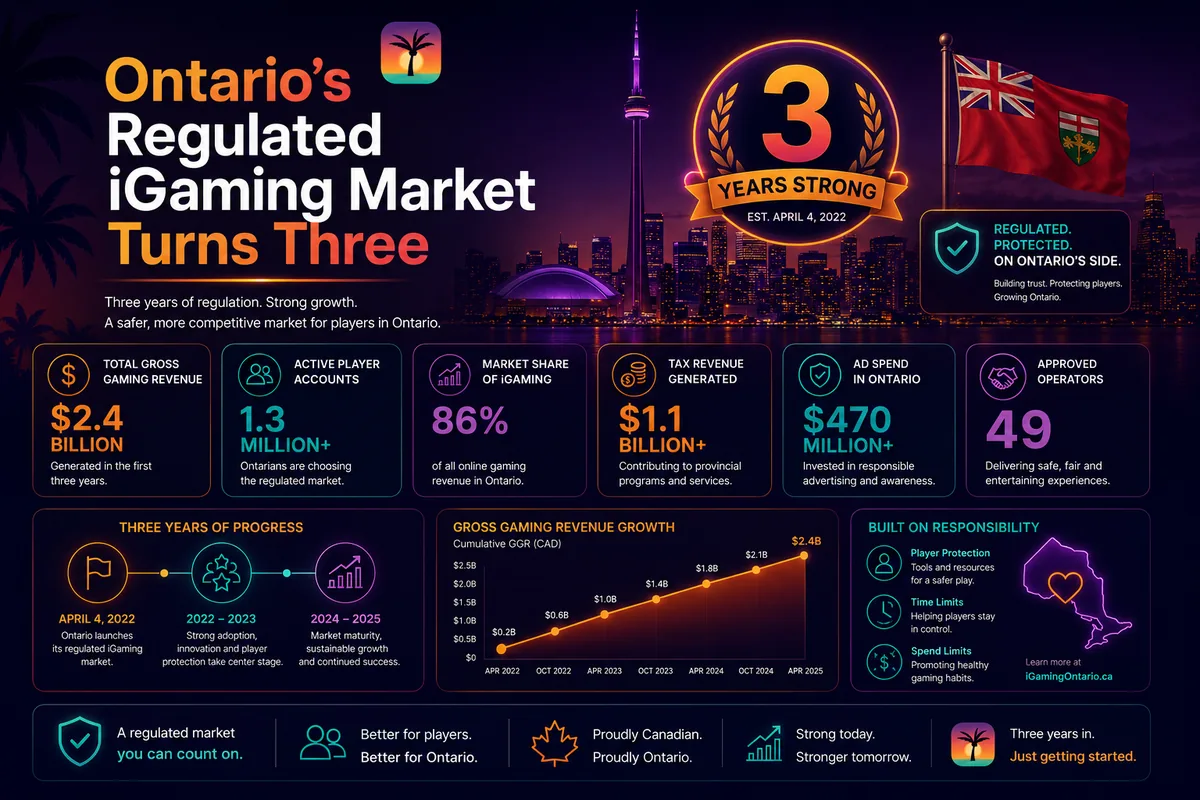
The headline figures are large, and we would ask you to treat them as reported and approximate rather than precise to the dollar. iGaming Ontario publishes quarterly market reports, and the trajectory across the first three years is clear even if the exact numbers move. Total wagers, the handle, has run into the tens of billions of dollars per quarter. Gaming revenue, what operators keep after paying out winnings, has climbed into the hundreds of millions per quarter and kept rising year on year. Active player accounts have been reported around the one million mark and above per quarter.
The operator count tells its own story. The market opened with a cluster of brands going live on day one and has since settled into roughly four dozen operators running around eighty to ninety gaming sites between them, since a single operator can run several brands. That is a crowded, genuinely competitive field by any regulated standard. Compare that to a typical US state where a player might see six or eight approved casino apps.
| Metric (reported, approximate) | Year 1 (2022-23) | Year 3 (2025-26) | Direction |
|---|---|---|---|
| Total quarterly wagers (handle) | ~$14bn | ~$25bn+ | Up sharply |
| Quarterly gaming revenue | ~$550m | ~$800m+ | Up |
| Active player accounts / quarter | ~900k | ~1.1m+ | Up |
| Operators / gaming sites live | ~30 / ~65 | ~45 / ~85 | Up, then steadying |
Two things about that table. The handle number always looks enormous because it counts every dollar staked, including re-wagered winnings, so a single hundred dollars can be bet many times over a session and inflate the total. Revenue is the truer measure of the market's size. And notice the operator count steadying rather than climbing forever. That is a market maturing, with the weaker brands consolidating into the stronger ones, which is exactly what a healthy competitive market does after its land-grab phase.
The channelisation story
If Ontario has one genuine success to point at, this is it. Channelisation is the share of all online gambling money in the province that flows through the regulated, licensed sites rather than through offshore or grey-market ones. It is the single number that tells you whether a regulated market is actually working, because a market can look busy while most of the real money still leaks abroad.
Independent research commissioned around the market's progress has put Ontario's channelisation high, in the region of 85 to 90-plus percent of players using regulated sites for at least some of their play, with the money channelisation climbing steadily as the grey market shrank. For context, that is a strong figure by international standards. Plenty of European markets have struggled to get past 70 percent, and a badly designed regime can sit far lower, which means most of the harm and most of the money stays somewhere the regulator cannot see or tax.
Why did Ontario channelise so well? Our read is that it comes back to the open model. Because the province welcomed the established international brands in rather than shutting them out, players did not have to abandon the sites they already used and trusted. They just found the same brand, now operating under an AGCO registration and an iGO agreement, with provincial protections attached. There was no painful migration to unfamiliar names. That is a design choice other jurisdictions underrate, and it is the clearest lesson Ontario offers.
Advertising and responsible-gambling rules that tightened
The first year was loud. Anyone watching a Toronto Maple Leafs game in that opening season will remember the wall of betting ads, celebrity spokespeople, and sign-up offers thrown at every commercial break. The backlash was fast and it was bipartisan, and the AGCO moved on it. This is worth dwelling on, because it shows the regulator adjusting the settings after launch rather than treating the original rulebook as fixed.
The most significant change was the restriction on advertising that uses athletes and, more broadly, figures who appeal to minors. From early in the market's life the AGCO moved to bar active and, in effect, most retired athletes from appearing in Ontario gambling ads, alongside cartoon characters, entertainers and social-media influencers with a strong under-18 following. The reasoning is direct: those figures normalise betting for exactly the audience the province most wants to keep out. Inducement and bonus advertising to the general public was also reined in, pushed toward being available only to players who actively seek it.
On the responsible-gambling side, the AGCO's standards require the familiar toolkit at every registered site: deposit limits, time limits, loss limits, reality-check reminders, and self-exclusion, all under a set of standards operators must meet to keep their registration. The point we would stress is that these are conditions of doing business, not voluntary features. An operator that quietly weakens them is risking its registration, which is a very different pressure from a site choosing whether to bother.
The tax and revenue picture
Ontario's cut does not work like a conventional gambling tax, and the distinction trips people up. Rather than charging a headline tax rate on revenue, iGO takes a contractual share of each operator's gaming revenue under the operating agreement, reported to be in the region of a fifth of gaming revenue for most operators. That money flows to the province. Across three years it has added up to well over a billion dollars returned to Ontario, a figure the government has been happy to publicise.
Where does it go? Provincial general revenue, broadly, with the framing that money which used to flow untaxed to offshore operators now supports Ontario services instead. That is the political case for the whole reform in one sentence, and it is a reasonable one. The counter-argument, which we think is fair to note, is that a government now collecting a share of gambling losses has a built-in incentive for those losses to stay healthy, which is the same tension every regulated gambling market carries. The safeguard is keeping the regulator, the AGCO, structurally distinct from the commercial arm, iGO, and so far that separation has largely held.
One practical note for players: none of this is a tax on you. Gambling winnings for a recreational player in Canada are generally not taxable income, and the provincial share is taken from the operator's revenue, not from your withdrawals. If a site ever implies otherwise, that is a flag worth treating seriously.
Ontario versus the typical US state model
This is where Ontario gets genuinely instructive, because it sits right next to the largest natural experiment in the opposite direction. The United States regulates online casino gambling state by state, and only a handful of states allow real-money online casinos at all. Each of those runs its own regulator, its own tax rate, and its own approved list, and a player who crosses a state line often cannot use the same account. Ontario took the single-province open approach instead. The contrast is sharp.
| Feature | Ontario open model | Typical US state model |
|---|---|---|
| Who runs the sites | Many private operators under iGO agreements | Private operators, often tethered to a land-based licence holder |
| Number of brands | Dozens competing province-wide | Usually a handful per state |
| Regulator | Single provincial body, the AGCO | A separate regulator in every state |
| Geographic scope | One province, one account | State by state, account often does not cross lines |
| Online casino availability | Full casino plus sports betting | Sports betting widespread; online casino in only a few states |
| Province / state revenue | Contractual share of gaming revenue | Tax rate on revenue, varies widely by state |
| Entry for new operators | Register and sign an agreement, relatively open | Often capped by number of available skins or partners |
The single biggest practical difference is online casino availability. Sports betting spread fast across US states after the federal ban fell, but full online casino gaming, slots and table games, remains legal in only a short list of them. Ontario offers the full product to every adult in the province from day one. The result is that a Toronto player has more regulated online casino choice than almost any American, while an American in most states has none at all and either plays sweepstakes-style workarounds or goes offshore. That gap is the whole argument for the open model, and it is why regulators across the continent keep asking Ontario how it did it.
What it means for players
Strip away the policy and here is what changed for an adult in Ontario. Playing on a regulated site now comes with provincial protections that a grey-market account never carried. Your funds sit with an operator held to AGCO standards. Game fairness and payout behaviour are subject to the regulator's technical standards rather than to a licence in a jurisdiction you have never heard of. And, critically, you have somewhere to go when something goes wrong.
Dispute paths are the part players discover only when they need them. On a regulated Ontario site, a complaint that the operator cannot resolve can be escalated through channels the regulatory framework recognises, and the AGCO can act against operators that breach standards. That is a world away from a grey-market dispute, where your practical recourse against an offshore licence is often close to nothing. We have said the same thing about every regulated market we cover: the value of a licence is not visible on a good day, it is visible on the day a withdrawal stalls.
Self-exclusion deserves its own line. Ontario players have access to responsible-gambling tools at the operator level and to provincial self-exclusion support, so a decision to step away can be enforced rather than merely intended. If you are using self-exclusion, the point of staying inside the regulated system is that the block is meant to hold across the sites bound by it. Chasing an offshore site to get around your own exclusion is the single most self-defeating move we see, and we will keep saying so. 18+, and if play has stopped being fun, use the tools before you need them.
Ontario iGaming, year by year
It helps to lay the three years out in sequence, because the story is really about a regulator adjusting a live market rather than a single launch event. Here is the shape of it, with dates and figures framed as reported and approximate.
| Period | What happened | Why it mattered |
|---|---|---|
| April 2022 | Regulated market opens; first operators go live under AGCO and iGO | North America's first open, competitive provincial iGaming market begins |
| Year 1 (2022-23) | Rapid onboarding of operators; heavy advertising; first quarterly reports published | Grey-market brands move onshore; ad backlash builds |
| 2023-24 | Advertising restrictions on athletes and youth-appealing figures take hold | Regulator tightens the rulebook after launch, not before |
| Year 2 (2024) | Handle and revenue climb; channelisation confirmed high by independent research | Evidence the open model was pulling money onshore |
| 2025 | Operator count steadies; consolidation begins; single-account court questions around inter-provincial play surface | Market matures from land-grab into competition on quality |
| Year 3 (2025-26) | Over a billion dollars cumulatively returned to the province; market treated as an international reference case | Ontario becomes the model others study |
Read down that column and the pattern is a regulator willing to change the settings while the market runs. The advertising clamp-down is the clearest example. Nothing about the original framework required athletes to disappear from betting ads, but the AGCO watched the first year, judged the effect on younger audiences, and acted. A regulator that can do that without collapsing the market is worth more than any single rule in the book.
What to watch next
Three things sit on our watch list. The first is the question of inter-provincial play. Ontario ring-fences its market to players physically in the province, and there has been legal argument about whether Ontarians should be able to pool into international player liquidity, which matters most for poker. How that lands could reshape the product for a slice of players and set a precedent other provinces read closely.
The second is whether other Canadian provinces follow. Ontario proved the open model can channelise well and return real money to the treasury, and provinces still running the older monopoly approach are watching the receipts. If one or two of the larger ones open up on a similar design, the Ontario template becomes a national pattern rather than a one-province experiment. That is the scenario most likely to reshape the Canadian map over the next few years.
The third is the long tail of harm. Channelisation and revenue are the easy wins to report. The harder number, and the one that actually decides whether this was good policy, is what happens to problem-gambling rates now that a large legal market exists with heavy advertising in its first phase. That data lags by years and is genuinely difficult to read cleanly. We will keep pointing at it, because a regulated market that channelises brilliantly and still lets harm climb has only solved the easy half of the problem. Ontario's first three years are a strong start. The next three are where the verdict actually gets written.
Frequently asked questions
When did Ontario's regulated iGaming market launch?
The regulated market went live in April 2022, making it the first open, competitive provincial online casino and sports-betting market in North America. It is run through two bodies: the AGCO, which regulates and registers operators, and iGaming Ontario (iGO), which signs the commercial operating agreements and collects the province's share of revenue.
How is Ontario's model different from the US state-by-state approach?
Ontario opened a single, province-wide market where dozens of private operators compete under one regulator, and full online casino gaming was available from day one. Most US states regulate separately, allow only a handful of approved brands, and legalise online casino gaming in just a few states while sports betting is far more widespread. An Ontario account works across the province; a US account often does not cross state lines.
What is channelisation and why does it matter for Ontario?
Channelisation is the share of online gambling that flows through regulated, licensed sites rather than offshore or grey-market ones. It is the truest test of whether a regulated market works, because money that leaks offshore cannot be taxed, monitored or made safe. Ontario has reported strong channelisation, high enough to sit well above many international markets, largely because it let established brands move onshore rather than shutting them out.
Are the ad rules stricter than when the market opened?
Yes. After a loud first year, the AGCO restricted the use of athletes and figures who appeal to minors, such as cartoon characters, entertainers and influencers with a young following, in Ontario gambling ads, and tightened rules on inducement and bonus advertising to the general public. It is a clear example of the regulator adjusting the rulebook after launch rather than leaving it fixed.
Do I pay tax on my winnings in Ontario?
For a recreational player, gambling winnings in Canada are generally not treated as taxable income. The province's revenue comes from a contractual share of each operator's gaming revenue under the iGO agreement, not from a tax on your withdrawals. If a site suggests it must withhold tax from your winnings, treat that as a warning sign and check the operator's registration.
What protections do I get on a regulated Ontario site?
Registered operators must meet AGCO standards covering fund handling, game fairness, and responsible-gambling tools like deposit, loss and time limits and self-exclusion. You also get a real dispute path: a complaint the operator cannot resolve can be escalated within the regulatory framework, and the AGCO can penalise operators that breach standards. A grey-market or offshore account carries none of that in any enforceable way.
We test operators the same way in every market: our own deposits, real play, and withdrawals we time to the minute. See the sites that clear our checks on the Palmy top-rated list. 18+ only. If gambling stops being fun, use the deposit limits and self-exclusion tools before you need them.