
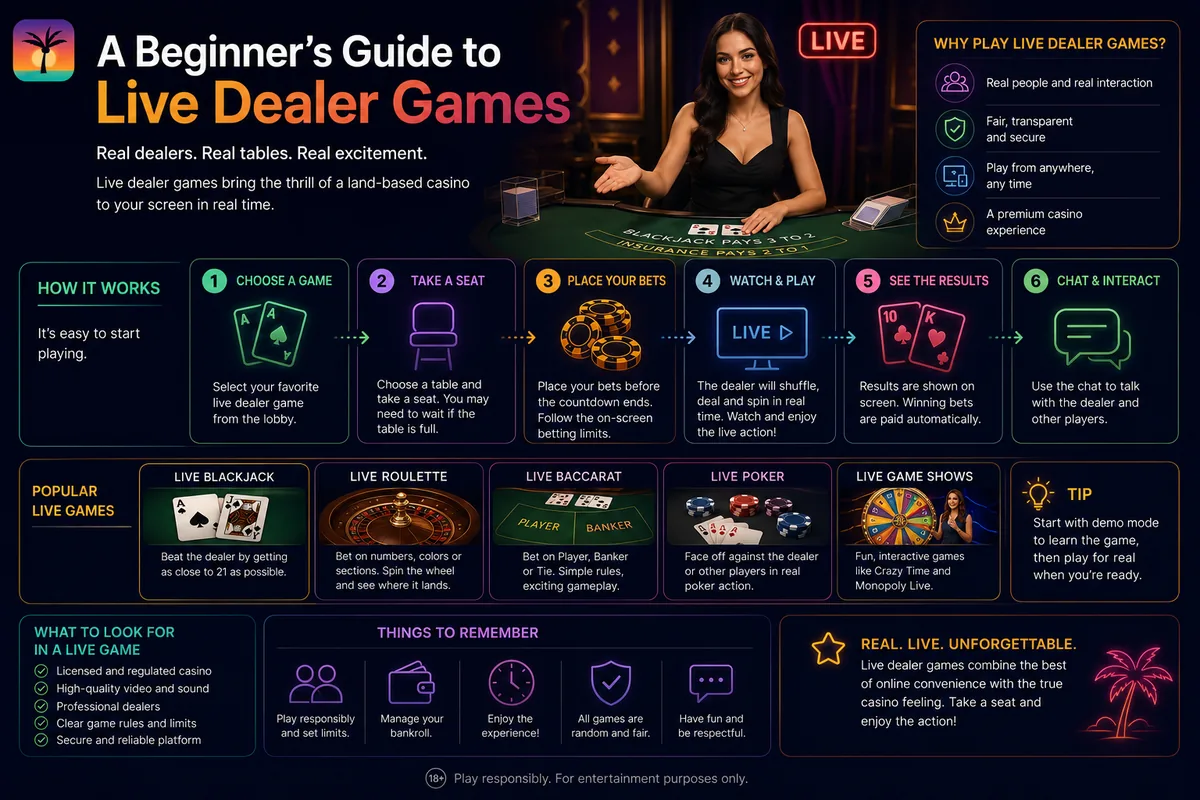
What live dealer actually is, and how it works
Live dealer is a real casino table filmed in a studio and streamed to your device in real time. A human dealer stands at a genuine blackjack felt or spins a real roulette wheel, cameras cover the action from a few angles, and you place your bets through buttons laid over the video. There is no cartoon wheel and no simulated shuffle. When the dealer flicks a card across the table, that is the card you are playing.
The clever bit is how your click becomes a bet. Most studios use optical character recognition, the same broad idea as a scanner reading text, to read the physical cards and the pocket the ball lands in, then feed that result back into the software so payouts settle automatically. Providers such as Evolution, Pragmatic Play Live and Playtech run these studios around the clock, often from sites in Malta, Latvia and Romania, and licence the feed to the casinos you actually log in to. So the brand on the felt is frequently not the brand on your account. That is normal and not a red flag.
You join a table, pick a chip value, and the round runs on a fixed clock. A banner counts down the seconds you have to bet, the dealer calls "no more bets", the hand or spin plays out on camera, and your balance updates. Then it resets and goes again. The rhythm is the whole appeal for a lot of people. It feels like a table, because it is one, just with the pit boss replaced by a countdown timer.
How it differs from RNG games
The games you have probably met first online, slots and the solo blackjack or roulette in the main lobby, are RNG games. RNG stands for random number generator, a piece of certified software that decides each outcome instantly. There is no dealer and no film. You are the only player at the table, you set the speed, and nothing happens until you press a button. Live dealer throws most of that out.
The first change is pace, and it cuts both ways. An RNG table lets you fire off a decision the moment the last one settles, so a fast player can rattle through a hundred hands in a few minutes. A live table waits for a real human to shuffle, deal and pay out, which caps you at roughly forty to sixty rounds an hour. That sounds slower and safer, and per round it is, but you are also sharing the table, so the dead time between your own decisions can quietly stretch a session for hours.
The second change is that live is social and shared. You are at a table with other players and a dealer who talks to the room, there is a chat box, and there is no autoplay and no turbo button to hide behind. You cannot pause a live table to think, and you cannot rewind it. There is also usually a table minimum, because a real dealer's time costs money, so the cheapest live seats often start higher than the one-cent RNG version of the same game. The table below lays the two side by side.
| Feature | RNG games | Live dealer games |
|---|---|---|
| Who runs the outcome | Certified software, instant | Real dealer, real cards and wheel, on camera |
| Pace | You set it, can be very fast | Fixed by the dealer, roughly 40 to 60 rounds an hour |
| Autoplay / turbo | Usually available | None, every round is manual |
| Social feel | Solo, silent | Shared table, live chat, dealer talks to the room |
| Minimum stake | Often a few cents | Higher, common floors of 0.50 to 5 euro |
| Bonus wagering | Slots usually count 100% | Often counts little or nothing, or is barred |
| Best for | Learning, tiny stakes, quick sessions | Table atmosphere, low-edge classic games |
Neither is better in the abstract. If you want to learn the rules of a game for pennies, an RNG table is the cheaper classroom. If you want the feel of a real table and you are drawn to the low-edge classics, live dealer earns its place. Just do not assume the live version is the safe version because it looks slower. The seat costs more per round, and the timer keeps the pressure on.
The core games, explained simply
Live studios run dozens of formats now, but four families cover almost everything a beginner meets. Two of them are among the fairest bets in the whole building. One of them is a television game show wearing a casino badge, and it will take your money faster than anything else on this page if you let it.
Live blackjack
You and the dealer each get cards, you try to get closer to 21 than the dealer without going over, and the maths of the game has been solved for decades. That solved answer is called basic strategy: a fixed chart of the correct hit, stand, double or split for every combination of your hand against the dealer's up card. Play it and the house edge on a standard game sits near 0.5 percent, which is about as good as casino gambling gets. Deviate on gut feel and that edge climbs quietly. The chart is free, it fits on one card, and most players who lose at blackjack lose because they will not use it, not because the cards were cruel.
Live roulette
The wheel and the ball, bet on where it lands. The one number that matters before you sit is how many zeros the wheel has. European and French roulette have a single zero and a house edge of 2.7 percent. American roulette adds a second green pocket, the double zero, and that one extra slot pushes the edge to 5.26 percent, nearly double, for exactly the same game. Always take the single-zero table. French roulette is better still on even-money bets, because the "la partage" rule hands back half your stake when the ball hits zero, dropping the edge on those bets to around 1.35 percent.
Live baccarat
The simplest game to play and one of the hardest to beat yourself with, because there is almost nothing to decide. You bet on Player, Banker or Tie, the cards are dealt to a fixed rule, and the closest to nine wins. Bet Banker. The Banker bet carries a house edge of about 1.06 percent, even after the 5 percent commission the casino takes on Banker wins. Player is close behind at 1.24 percent. The Tie, which pays a tempting 8 to 1, has an edge of over 14 percent and is a trap. Ignore it and baccarat is one of the best-value seats you will find.
Money wheels and game shows
These are the bright, loud formats, Crazy Time, Monopoly Live, Dream Catcher and the rest, built to look like Saturday-night television. A host spins a giant wheel, there are bonus rounds and multipliers, and they are genuinely fun to watch. They are also the worst value on the floor. The core bets and especially the flashy side segments carry a house edge that commonly runs from around 5 percent up past 8 percent, several times the cost of the blackjack table two clicks away. The multipliers are real, but they are priced in. Treat these as paid entertainment, not as a game you are trying to win, and stake them accordingly.
| Live game | Typical house edge | Best bet | Bet to skip |
|---|---|---|---|
| Blackjack (basic strategy) | ~0.5% | Play the strategy chart | Insurance, most side bets |
| Baccarat | ~1.06% on Banker | Banker | Tie (over 14% edge) |
| French roulette | ~1.35% on even-money bets | Even-money with la partage | Single-number long shots |
| European roulette | 2.7% | Single-zero table, outside bets | Any American double-zero wheel |
| American roulette | 5.26% | Just don't, take the single zero | The whole table if a single zero exists |
| Game shows / money wheels | ~5% to 8%+ | Lowest-edge main bet only | High-multiplier side segments |
Read that table as a ranking of value, not of fun. Plenty of people we know would rather spend an hour on Crazy Time than a solved blackjack chart, and there is nothing wrong with that as long as you know you are paying a premium for the show. What you should not do is drift onto a double-zero wheel or start feeding the Tie bet without realising the price just doubled or worse.
Etiquette and the interface
The controls are simpler than they look, and they are roughly the same across studios once you have seen one. You choose a chip value from a rack at the bottom, click the part of the felt you want to bet, and repeat to stack more. A timer, usually ten to fifteen seconds, counts your betting window. When it ends the dealer acts, and there is no reaching in after that. Miss the window and you simply sit out that round, which is fine, it happens to everyone on their first few tables.
Most tables carry a chat box. It is there for a bit of banter with the dealer and the room, and dealers do read it and reply by name, which is part of why people play live. Keep it civil. Abuse gets you muted or removed, and the dealer cannot change a result no matter what you type at them. There is no obligation to chat at all; plenty of players never say a word.
Tipping exists on some live tables, usually a small button that sends a token gratuity to the dealer, and it is entirely optional. It does nothing to your odds and nothing to the outcome. Tip if a dealer made the session pleasant and you feel like it, skip it otherwise, and never treat it as a lever on your luck, because it is not one. The single habit worth building here is small: know where the chip selector and the bet-repeat button are before your first real round, so you are not fumbling while the clock runs down.
Bankroll and pace, the part that bites
Here is the honest warning, and it is the reason we wanted to write this guide. Live dealer feels slower than slots, so it feels safer, and that feeling is a trap. Do the arithmetic. Fifty rounds an hour at a 5 euro minimum is 250 euro staked every hour before you have done anything reckless. On a game-show table where the edge might be 7 percent, the maths expects that to cost you around 17 to 18 euro an hour on average. On a slot at 4 euro a spin and six hundred spins an hour, you would stake far more, but the point stands: the calm pace of live does not mean cheap.
Set your limits before you sit, not while you are sitting. Decide the money you are willing to lose for the session's entertainment, and treat it as spent the moment you deposit, the way you would treat a ticket to a match. Most licensed casinos let you set a deposit limit and a session reminder in the account settings, and we use them ourselves precisely because the timer and the shared table make it easy to lose track of the clock. Pick a stake that gives you at least twenty rounds of buffer at the table minimum, so one cold streak does not end the night.
Chasing losses is the specific danger live tables encourage, because the next round is always fifteen seconds away and the room is still going. If you find yourself raising your stake to win back what the last spin took, that is the moment to close the tab, not to place one more bet. The maths never cares how the previous round went. Every new round starts the house edge from scratch.
What to check before you sit down
Sixty seconds of checks saves a lot of regret. Four things are worth confirming before you put money on a live table, and none of them need any special knowledge.
Check the table limits first. Every live table shows its minimum and maximum bet on the lobby tile before you join. Match that to your bankroll, not the other way around, and if the cheapest seat is more than you planned to stake per round, find a lower table or a different provider rather than stretching. Then check the specific bet you intend to play, because the RTP on a game is not the RTP on every bet within it. A blackjack table with good rules is near 99.5 percent, but the side bets bolted onto it, the 21+3 and Perfect Pairs style extras, often run house edges of 5 percent and up. The main game and the side bet are two different products at one felt.
Check the stream quality, briefly, because it tells you who you are dealing with. A sharp, stable feed with clear card reads is the sign of a real studio provider. A laggy, low-resolution stream, or one where you cannot tell what the dealer dealt, is a reason to leave; you should never bet on an outcome you cannot see. The last check is the one beginners miss most. If you are playing with a bonus, read whether live dealer counts toward the wagering requirement, because very often it does not. Slots typically clear a bonus at 100 percent, while live games commonly count at 10 percent, zero, or are barred outright during wagering, and playing an excluded game can void the bonus and any winnings with it. Our guide to RTP and volatility walks through that clause in detail.
Common beginner mistakes
Most first-timer losses are not bad luck, they are the same handful of avoidable errors. Playing blackjack on gut feel instead of the basic-strategy chart is the biggest, and it is the easiest to fix, because the chart is free and turning a 2 percent self-inflicted edge back into 0.5 percent is pure profit. Sitting at an American double-zero roulette wheel when a single-zero one is right there is the next, and it silently doubles the price of every spin you make.
Then come the side bets. The Tie in baccarat, insurance in blackjack, the multiplier segments on the game shows, all of them dangle a big payout in front of a genuinely poor edge, and all of them are optional. Skipping every side bet on the table costs you nothing and improves your expected return on almost every game. The chat and the atmosphere are there to keep you playing, which is fine when you are playing for the show and dangerous when you have started chasing, so learn to tell the difference in yourself.
The last mistake is treating a bonus as free money on the wrong game. Depositing to grab a match, then grinding it out on live blackjack because you enjoy it, is a common way to discover at cash-out that the live play cleared none of the wagering. Play the game you enjoy with your own funds, and clear any bonus on the games the terms actually credit. Keep the two jobs separate and live dealer stays what it should be: a good-looking table with a couple of genuinely fair seats, played at a stake you decided on before the timer started.
Frequently asked questions
Are live dealer games rigged or fixed?
No more than any casino game, and arguably less, because you can watch the cards and the wheel yourself. Licensed studios are audited and the physical equipment is inspected. The house edge is real and always favours the casino over time, but that is built into the odds openly, not hidden in the software. Stick to casinos licensed by a recognised regulator such as the UK Gambling Commission or the Malta Gaming Authority.
Which live game gives me the best chance?
Blackjack played with basic strategy has the lowest house edge, around 0.5 percent. Baccarat on the Banker bet is close at about 1.06 percent, and it needs no strategy at all beyond ignoring the Tie. Single-zero roulette sits at 2.7 percent. Avoid American double-zero roulette and the high-edge game-show side bets if value is what you care about.
Do I need to chat or tip the dealer?
No to both. The chat is optional social banter and plenty of players stay silent. Tipping is a small optional button on some tables that sends a gratuity to the dealer, and it has zero effect on your odds or the outcome. Tip only if you feel like it, never as a way to influence the game.
Why does live dealer cost more per round than the RNG version?
A real dealer's time and a filmed studio cost money, so table minimums are higher, often 0.50 to 5 euro against a few cents for the RNG lobby game. The pace also feels calm but adds up: fifty rounds an hour at a 5 euro minimum is 250 euro staked hourly. Slower per round does not mean cheaper per hour.
Does live dealer count toward a bonus wagering requirement?
Usually not at full value, and often not at all. Slots typically contribute 100 percent to wagering, while live dealer games commonly count at 10 percent, zero, or are excluded entirely. Playing an excluded game during wagering can void the bonus and any winnings, so read the game-weighting clause before you deposit for an offer.
Can I learn live blackjack without risking money first?
Yes. Learn the rules and basic strategy on a free-play RNG table, or on a printed strategy chart, before you sit at a live table. Live dealer games do not usually offer a demo mode because there is a real dealer involved, so the cheap classroom is the RNG version. Bring the chart to your first live session and follow it.
Every casino we rank runs on our own deposits, timed withdrawals and hours of table play, live dealer included. See which sites cleared the desk on our top-rated casinos. 18+ only, please gamble responsibly.